
Showing posts with label Kolleru Lake. Show all posts
Showing posts with label Kolleru Lake. Show all posts
January 18, 2016
Spot-billed pelican / గూడకొంగ / గూడబాతు / దేవరాయి కొంగ / కొల్లేటి కొంగ.
January 15, 2016
Spot-billed pelican / గూడకొంగ / గూడబాతు / దేవరాయి కొంగ / కొల్లేటి కొంగ.

A migratory bird of a large size weighing 6-9 Kgs (avg) flies in flocks and mostly lives in the Marsh lands, preying on the fish, flying and honking.. Can eat an average to big sized fish in a gulp having the sack kind of skin / muscles supporting the lower jaw..
January 10, 2016
Kolleru Bird Sanctuary Series - Post 8
Abode for the migratory birds and an interesting destination for the bird lovers.
<Continued from the Post 7>
What you see in the background are the huge reeds of the "Elephant grass" with which Kolleru Lake is infested and affected, next in intensity to the Human encroachments.
But a lot of nesting happens in between and also the nesting material is offered to the birds.

December 13, 2015
Indian Pond Heron / గుడ్డికొంగ / గుడ్డికొక్కిరి

Moving / Floating around on a Water Hyacinth - observed to be the favorite and natural practice of Pond Heron to access the deeper waters. Generally settle and move around slowly on the edges of the water-bodies to hunt their primary food which includes the acquatic insects, small fish, and tadpoles.
Their habit of standing still for most of the time and moving / flying selectively triggered the folk-beliefs that hey are blind / semi-blind and their local names (in many India languages) indicate the same..
December 12, 2015

December 08, 2015
Indian Pond Heron / గుడ్డికొంగ / గుడ్డికొక్కిరి

Moving / Floating around on a Water Hyacinth - observed to be the favorite and natural practice of Pond Heron to access the deeper waters. Generally settle and move around slowly on the edges of the water-bodies to hunt their primary food which includes the acquatic insects, small fish, and tadpoles.
Their habit of standing still for most of the time and moving / flying selectively triggered the folk-beliefs that hey are blind / semi-blind and their local names (in many India languages) indicate the same..
December 07, 2015
Kolleru Bird Sanctuary Series - Post 7
Abode for the migratory birds and an interesting destination for the bird lovers.
<Continued from the Post 6>

Picture: Spot-billed pelican / గూడకొంగ / గూడబాతు / దేవరాయి కొంగ / కొల్లేటి కొంగ.
A migratory bird of a large size weighing 6-9 Kgs (avg) flies in flocks and mostly lives in the Marsh lands, preying on the fish, flying and honking.. Can eat an average to big sized fish in a gulp having the sack kind of skin / muscles supporting the lower jaw..
Little Egret / తెల్ల కొంగ / శాంతి కొంగ

Also known for bringing luck, as per the fairy tales of childhood.
December 04, 2015
Kolleru Bird Sanctuary Series - Post 6
Abode for the migratory birds and an interesting destination for the bird lovers.
<Continued from the Post 5>
What you see in the background is the huge reeds of the "Elephant grass" with which Kolleru Lake is infested and affected, next in intensity to the Human encroachments.
But a lot of nesting happens in between and also the nesting material is offered to the birds..
What you see in the background is the huge reeds of the "Elephant grass" with which Kolleru Lake is infested and affected, next in intensity to the Human encroachments.
But a lot of nesting happens in between and also the nesting material is offered to the birds..

Picture: Grey Heron / నారాయణ పక్షి
December 03, 2015
Kolleru Bird Sanctuary Series - Post 5
Abode for the migratory birds and an interesting destination for the bird lovers.
<Continued from the Post 4>

Picture: Indian Pond Heron / గుడ్డికొంగ / గుడ్డికొక్కిరి
Moving / Floating around on a Water Hyacinth - observed to be the favorite and natural practice of Pond Heron to access the deeper waters. Generally settle and move around slowly on the edges of the water-bodies to hunt their primary food which includes the acquatic insects, small fish, and tadpoles.
Their habit of standing still for most of the time and moving / flying selectively triggered the folk-beliefs that hey are blind / semi-blind and their local names (in many India languages) indicate the same..
December 02, 2015
Kolleru Bird Sanctuary Series - Post 4
Abode for the migratory birds and an interesting destination for the bird lovers.
<Continued from the Post 3>

Picture: Bird Meal.. Fish bone / Fish Skeleton
Kolleru Lake, which is said to be attracting an estimated number of 2 Million flying visitors between the months October and March, keeps itself ready with a full-aquatic-platter.
December 01, 2015
Blue-tailed Bee-eater / పసిరిక

Richly colored bird species and as the name suggests, bee-eaters predominantly eat flying insects, especially bees and wasps.
Interestingly, before eating its meal, a bee-eater removes the stinger by repeatedly hitting and rubbing the insect on a hard surface. During this process, pressure is applied to the insect thereby extracting most of the venom. Notably, the birds only catch prey that are on the wing and ignore flying insects once they land.
Info Source: Wikipedia
November 30, 2015
Kolleru Bird Sanctuary Series - Post 3
Abode for the migratory birds and an interesting destination for the bird lovers.
<Continued from the Post 2>

Picture: Indian Pond Heron / గుడ్డికొంగ / గుడ్డికొక్కిరి
Moving / Floating around on a Water Hyacinth - observed to be the favorite and natural practice of Pond Heron to access the deeper waters. Generally settle and move around slowly on the edges of the water-bodies to hunt their primary food which includes the acquatic insects, small fish, and tadpoles.
Their habit of standing still for most of the time and moving / flying selectively triggered the folk-beliefs that hey are blind / semi-blind and their local names (in many India languages) indicate the same..
Kolleru Bird Sanctuary Series - Post 2
Abode for the migratory birds and an interesting destination for the bird lovers.
<Continued from the Post 1>
Encroachments in the form of few paddy fields, numerous fish-farming tanks and human intrusion have increased the pollution, imbalanced the ecological diversity and ultimately influenced adversely the rainfall pattern in the region.
Rich in flora and fauna, it attracts migratory birds from northern Asia and Eastern Europe between the months of October and March. During this season, the lake is visited by an estimated two million birds.
The resident birds include grey pelicans, Asian open-billed storks (Anastomus oscitans), painted storks (Mycteria leucocephala), glossy ibises, white ibises, teals, pintails and shovellers. The migratory birds include red-crested pochards, blackwinged stilts, avocets, common red shanks, wigeons, gadwalls and cormorants, garganeys, herons and flamingos.

Picture: Indian Cormorant / చెఱవుకాకి / నీటికాకి..
Known to be the hungriest among the water-birds, spends most of the time locating, diving, fishing and eating its prey.Info Source: Wikipedia
November 29, 2015
Kolleru Bird Sanctuary Series - Post 1
Abode for the migratory birds and an interesting destination for the bird lovers.
One among the India's Largest freshwater lakes, Kolleru spreads across 300 Sq.Km in the Krishna - Godavari (river) delta in AndhraPradesh and acts as the natural flood-balancing reservoir for the above said rivers.
The vast water-body and marshy lands attract not only the inland birds but also the migratory ones like Siberian Cranes, Pelicans and Storks.
Though declared to be a Wildlife Sancturay under the Indian Wildlife protection act, encroachments and the illegal fish-farming shrunk the lake and scaring the flying visitors away..

Picture: Spot-billed pelican / గూడకొంగ / గూడబాతు / దేవరాయి కొంగ / కొల్లేటి కొంగ.
A migratory bird of a large size weighing 6-9 Kgs (avg) flies in flocks, all the way from Siberia to the peninsular India, SriLanka and surroundings in love for the tropical climates and to breed.
Mostly lives in the Marsh lands, preying on the fish, flying and honking.. Can eat an average to big sized fish in a gulp having the sack kind of skin / muscles supporting the lower jaw..
<More pictures and details to follow>
February 14, 2015
Chilling-out after a heavy lunch...

A migratory bird of a large size weighing 6-9 Kgs (avg) flies in flocks, all the way from Siberia to the peninsular India, SriLanka and surroundings in love for the tropical climates and to breed.
Mostly lives in the marsh lands, preying on the fish, flying and honking.. Can eat an average to big sized fish in a gulp having the sack kind of skin / muscles supporting the lower jaw..
Shot at Kolleru Bird Sanctuary located between the Krishna and Godavari river Delta.
February 05, 2015
One more from the Pelican series..

A migratory bird of a large size weighing 6-9 Kgs (avg) flies in flocks, all the way from Siberia to the peninsular India, SriLanka and surroundings in love for the tropical climates and to breed.
Mostly lives in the marsh lands, preying on the fish, flying and honking.. Can eat an average to big sized fish in a gulp having the sack kind of skin / muscles supporting the lower jaw..
Shot at Kolleru Bird Sanctuary located between the Krishna and Godavari river Delta.
February 01, 2015
Hovering for a safe-landing...

A migratory bird of a large size weighing 6-9 Kgs (avg) flies in flocks, all the way from Siberia to the peninsular India, SriLanka and surroundings in love for the tropical climates and to breed.
Mostly lives in the marsh lands, preying on the fish, flying and honking.. Can eat an average to big sized fish in a gulp having the sack kind of skin / muscles supporting the lower jaw..
Shot at Kolleru Bird Sanctuary located between the Krishna and Godavari river Delta.
December 21, 2014
Spot-billed pelican / గూడకొంగ / గూడబాతు / దేవరాయి కొంగ / కొల్లేటి కొంగ

Mostly lives in the marsh lands, preying on the fish, flying and honking.. Can eat an average to big sized fish in a gulp having the sack kind of skin / muscles supporting the lower jaw..
Shot at Kolleru Bird Sanctuary located between the Krishna and Godavari river Delta.
November 13, 2014
Welcome Home...!!!
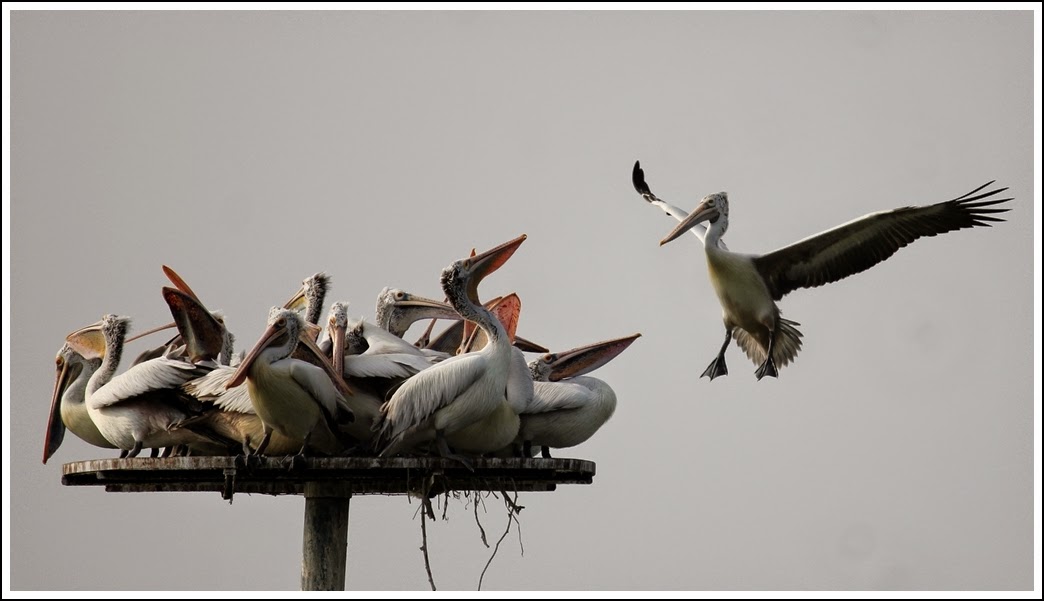
Spot-billed pelican / గూడకొంగ / గూడబాతు / దేవరాయి కొంగ / కొల్లేటి కొంగ.
A migratory bird of a large size weighing 6-9 Kgs (avg) flies in flocks, all the way from Siberia to the peninsular India, SriLanka and surroundings in love for the tropical climates and to breed.
Mostly lives in the marsh lands, preying on the fish, flying and honking.. Can eat an average to big sized fish in a gulp having the sack kind of skin / muscles supporting the lower jaw..
Shot at Kolleru Bird Sanctuary located between the Krishna and Godavari river Delta.
Subscribe to:
Posts (Atom)